Showing posts with label temperature quilt along. Show all posts
Monday, March 9, 2020
Temperature Quilt Update
I caught up my temperature quilt to March 2 last week. I'm on the third row! There is a certain satisfaction in growing a quilt this way!
Got up to a new highest temperature on March 1. Over 54. March definitely came in a like a quiet, warm lamb. Not as many colder temperatures, either. Although when I check the forecast I'm always secretly hoping for variations from day to day to make the quilt more interesting. :)
The process of making these Quilt As You Go Hexagons can get a bit tedious with all the folding and ironing (read about the process here)
I was so excited to remember that a few years ago I had bought a Martelli Round About Set. It has an ironing top and a cutting mat on a turn table.
Now I can iron and spin. Every time saving thing helps!
Friday, February 21, 2020
Quilt as You Go Hexagons - A Quick Tutorial
You also need to decide on the sizes you want to end up with. My inside hexagon is 4.5" hexagon marked on the Hex N More. This is a nice size for me to cut the half hexies to do highs and lows for each day.
The background needs to be one inch bigger on each side, so that actually means two inches larger (it took me a while to actually get this) So in my case I make a 4.5" inside hexagon and cut a 6.5" hexagon for the background.
My current stack of backgrounds for Winter. With bonus triangles.
You also need to cut batting to the inside hexagon size. 4.5" in my case. I am using Warm and Natural because its what I had. You definitely do not want a thick batting.
Background plus batting.
Center batting and then front side hexagon. I like to steam press at this point. Helps keep it from shifting and flattens it a bit.
On each side fold up and press. Do not fold the edge of fabric all the way to the batting, you want to leave a small gap to make the turning up easier. Otherwise things get too bulky too quickly.
Here each side is folded once, close to the edge of the batting/top hexagon.
The next fold you take is going to come over the top hexagon, covering the raw edge of the top hexie and the batting. Continue to press.
Make sure to miter those corners carefully.
These corners aren't stellar, you can do better! (so can I)
Now you are going to stitch around the edge on top of the hexagon through all the layers. I just did a straight stitch, some like to use a decorative stitch.
For joining hexagons together you can use a zigzag or a decorative stitch.
Here is a close up of my temperature quilt so far. It is not perfect. I'm sure it could be better, but I don't have grand plans for this one other than the fun of making it.
The advantage of this method is you can just continue to grow the quilt.
There is a lot more work and time up front, but when you are done putting the blocks together, they are done forever.
It does also take a lot of fabric. Three yards of fabric yielded about 90 6.5" hexagons for the background.
Please let me know if you have any questions or I made any errors.
Wednesday, September 6, 2017
Temperature Quilt 2017 Update
Here we are into the first days of September already. Time flies, eh? I've got my Temperature quilt up to date through yesterday. (yep 9/5/17) In reality I'm quite sure I won't get back to it until after my local guild's quilt show. I have some responsibilities for the show and a couple of quilts I'd like to finish.
So: All the months so far.
January with one freakish warm day.
February - with a bunch of record breaking warm days.
March. One recording breaking warm day.
April
May
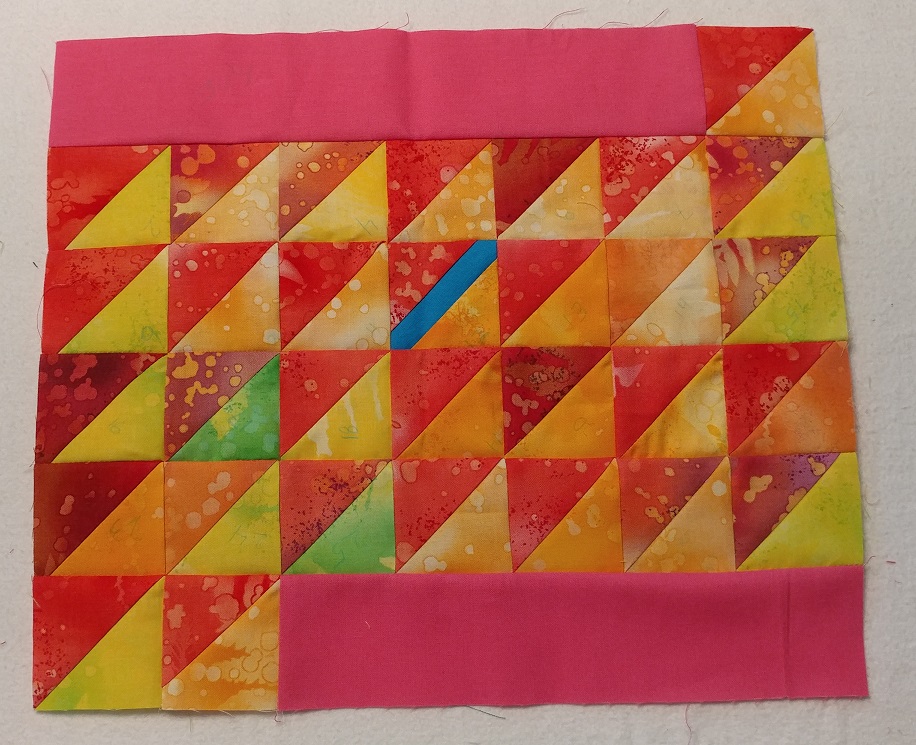
June. That white stripe is a record breaking cold temperature!
July. Warm. The blue stripe? Record breaking rainfall. There was major flooding all around the area. Our yard was saturated and we got water in the basement - that's impressive since we live on the top of a hill.
August - no records - but I wanted to make note of the solar eclipse.
Just a small embroidered circle. Black in the center, gold on the edge.
September. Another record cold evening.
All the months lined up so far. Colors will start shifting back to greens and blues as we are at the final four months of the year.
So: All the months so far.
January with one freakish warm day.
February - with a bunch of record breaking warm days.
March. One recording breaking warm day.
April
May
June. That white stripe is a record breaking cold temperature!
July. Warm. The blue stripe? Record breaking rainfall. There was major flooding all around the area. Our yard was saturated and we got water in the basement - that's impressive since we live on the top of a hill.
August - no records - but I wanted to make note of the solar eclipse.
Just a small embroidered circle. Black in the center, gold on the edge.
September. Another record cold evening.
All the months lined up so far. Colors will start shifting back to greens and blues as we are at the final four months of the year.
Wednesday, February 8, 2017
Temperature Quilt 2017: January
Finally sitting down to write up some blog posts.
January is all done - and so are the blocks for my temperature quilt.
You can see we had a couple of freak warm days in there.
I posted the following pictures on Instagram for some feedback on background choices. Chocolate, dark chocolate and pink! I confess I'm leaning toward pink.


January is all done - and so are the blocks for my temperature quilt.
You can see we had a couple of freak warm days in there.
I posted the following pictures on Instagram for some feedback on background choices. Chocolate, dark chocolate and pink! I confess I'm leaning toward pink.


Friday, January 6, 2017
The Temperaure Quilt 2017 Quilt Along
I mentioned a couple of posts ago I was debating about doing a Temperature Quilt this year. I mentioned it on Instagram, too, and between the two, at least three people expressed that they wanted to do it too! So I guess I'm making it official.
So lets talk about a couple things if you want to play along.
1. Fabrics. You will need a range of fabrics representing the range of temperatures for where you live. You can usually find your extremes by a web search. Here in WI I'm ready for a range of:
-20 through 109 degrees Farenheit. I've assigned them every 5 degrees for more interest. You could do every 10 degrees and use less fabric. Maybe if you live in a place that doesn't change much you could do every 1 or 2 degrees.
2. Timing. I found it worked best to do blocks for a week at a time. Usually on Sunday afternoons I would pull out the fabrics, write down the numbers for the week and then make the blocks. Two weeks is doable, but more than that takes a while.
3. Getting your information. I would recommend getting your temperature from a consistent source. Where I live it matters quite a bit, because Lake Michigan causes something called "Lake Effect" which means the closer you are to the lake, the more the weather and temperatures can change. Generally cooler in the summer and warmer in the winter. I really like Weather Underground because they keep a historical calendar, so you can look up all the past information you need.
4. Rules. Well, there aren't really any. At least not yet. If I get enough interest I'll see what I can do about prizes and motivation and such. I will for sure write a post once a month for progress and encouragement.
This was my original mock-up from 2014. My quilt turned out pretty close. I only did each day's high.
The following is loosely what I'm planning. I will for sure do half square triangles for highs and lows. I will not do so much sashing (the grey) if any at all. I consider this an evolving project.
Here are some other ideas for you to check out.
The half square triangles are for highs and lows. Each vertical row is a month.
Vertical rows, no sashing.
Vertical rows, sashing, highs only.
This quilt along is really quite free form - the few people I've talked to have different ideas they are trying out. Hexies and diamonds have both been brought up.
So, if you are interested - go ahead and leave a comment on this blog post - or on Instagram. We'll use the hashtag #tempquilt17. Tell all your friends. If it gets bigger than a few comments - I'll look into an official sign up sheet.
If you comment below, make sure you are NOT a no-reply blogger. If you are, I cannot reply back to you.

So lets talk about a couple things if you want to play along.
1. Fabrics. You will need a range of fabrics representing the range of temperatures for where you live. You can usually find your extremes by a web search. Here in WI I'm ready for a range of:
-20 through 109 degrees Farenheit. I've assigned them every 5 degrees for more interest. You could do every 10 degrees and use less fabric. Maybe if you live in a place that doesn't change much you could do every 1 or 2 degrees.
2. Timing. I found it worked best to do blocks for a week at a time. Usually on Sunday afternoons I would pull out the fabrics, write down the numbers for the week and then make the blocks. Two weeks is doable, but more than that takes a while.
3. Getting your information. I would recommend getting your temperature from a consistent source. Where I live it matters quite a bit, because Lake Michigan causes something called "Lake Effect" which means the closer you are to the lake, the more the weather and temperatures can change. Generally cooler in the summer and warmer in the winter. I really like Weather Underground because they keep a historical calendar, so you can look up all the past information you need.
4. Rules. Well, there aren't really any. At least not yet. If I get enough interest I'll see what I can do about prizes and motivation and such. I will for sure write a post once a month for progress and encouragement.
This was my original mock-up from 2014. My quilt turned out pretty close. I only did each day's high.
The following is loosely what I'm planning. I will for sure do half square triangles for highs and lows. I will not do so much sashing (the grey) if any at all. I consider this an evolving project.
Here are some other ideas for you to check out.
The half square triangles are for highs and lows. Each vertical row is a month.
Vertical rows, no sashing.
Vertical rows, sashing, highs only.
This quilt along is really quite free form - the few people I've talked to have different ideas they are trying out. Hexies and diamonds have both been brought up.
So, if you are interested - go ahead and leave a comment on this blog post - or on Instagram. We'll use the hashtag #tempquilt17. Tell all your friends. If it gets bigger than a few comments - I'll look into an official sign up sheet.
If you comment below, make sure you are NOT a no-reply blogger. If you are, I cannot reply back to you.

Subscribe to:
Posts (Atom)